
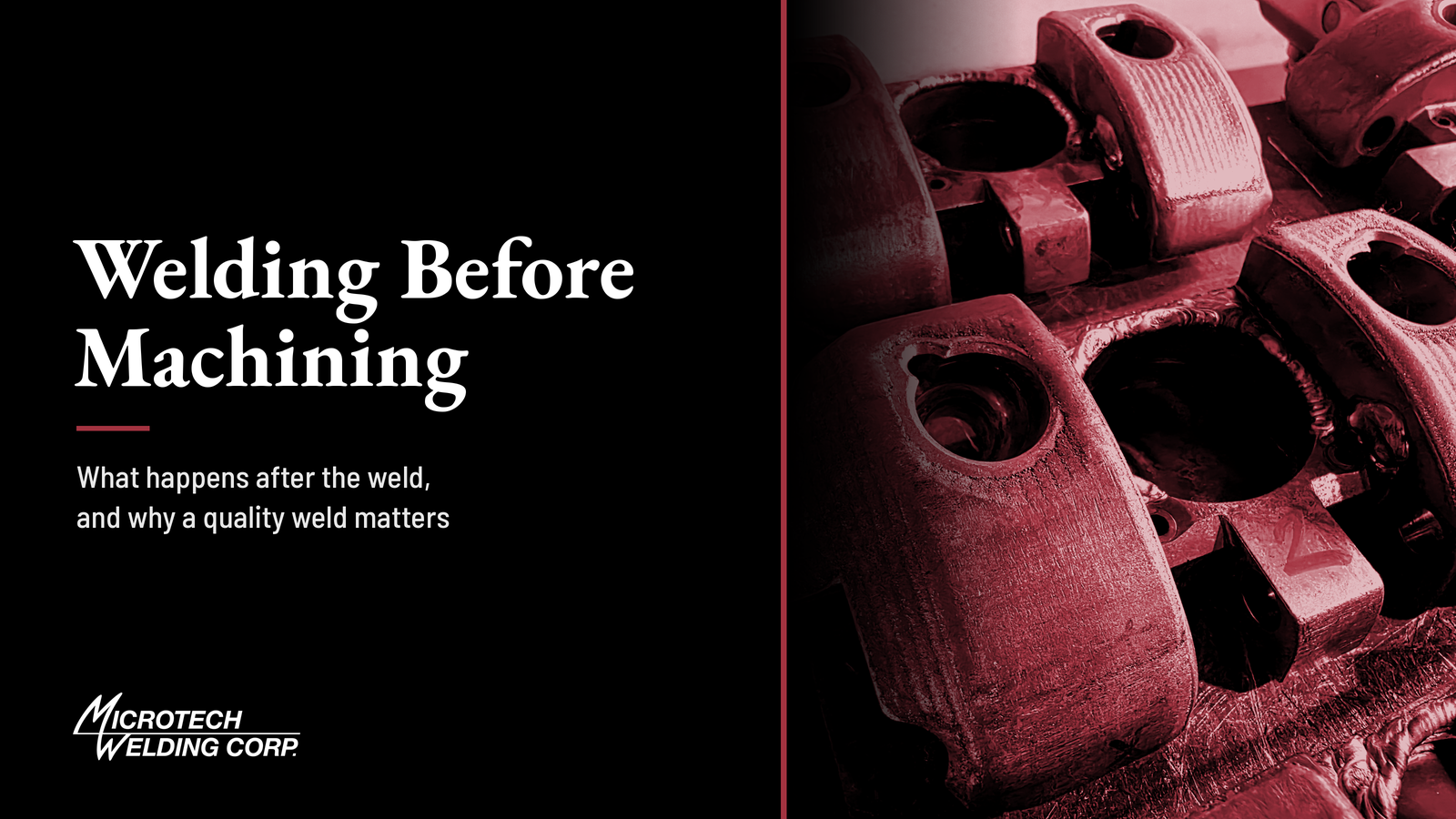
Some of the parts we weld don’t go straight into an assembly. They go to a mill, lathe, grinder, or polishing station, where someone cuts into the weld metal we just laid down. We provide welding services only and don’t do any machining, so the next operation is where a problem inside the weld, or a part that moved during welding, shows up. A clean weld lets that operation run as planned. Trapped porosity, excess distortion, or the wrong filler means rework.
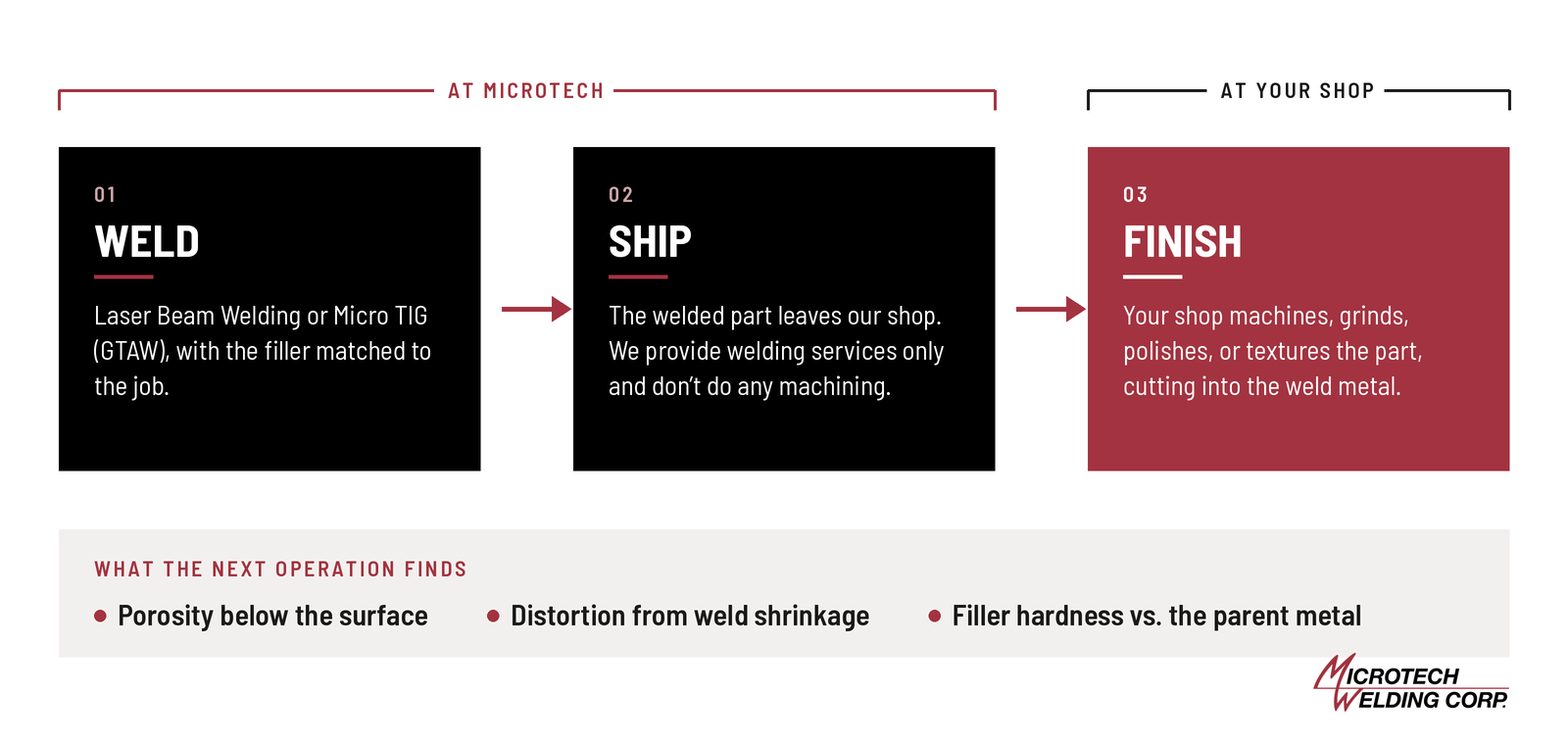
What Happens to the Part After It Leaves Us
Depending on the part, the bead might be ground flush, a sealing face might be machined flat, a mold insert might be polished or textured, or a repaired die feature might be cut back to print. The weld metal is now part of the stock that the operation must remove or finish.
Porosity Below the Surface
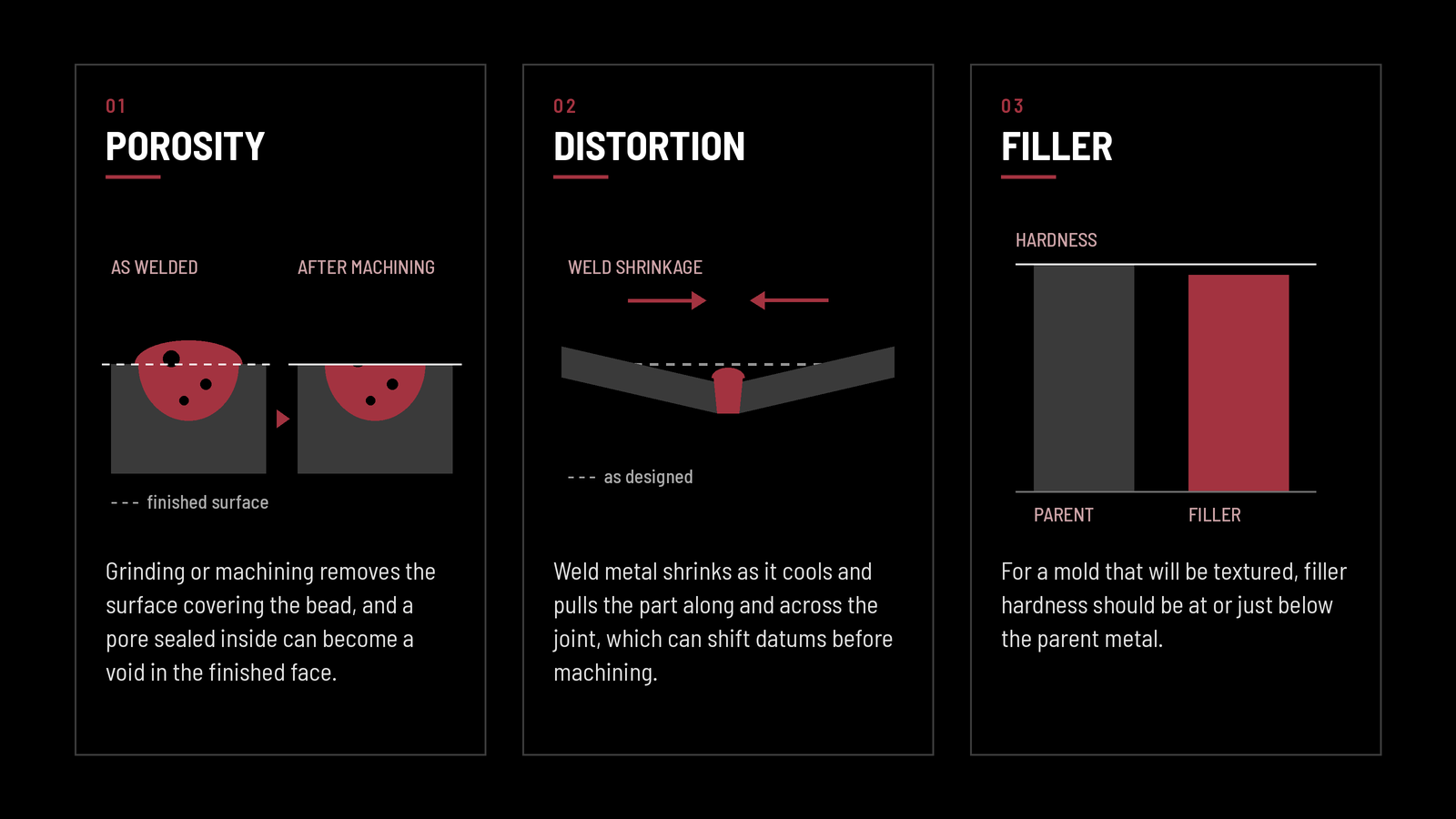
Porosity is gas that gets trapped in the weld metal as it solidifies. It can show up as pinholes on the surface or sit below it, where it’s found with radiography or ultrasonic inspection. Most welds carry some porosity, and the acceptance criteria for the joint define how much is allowable. A weld can meet those criteria as welded, but grinding or machining removes the surface covering it, and a pore sealed inside the bead can become a void in a finished face.
After grinding a cover we welded, one customer told us the ground areas had no voids, no porosity, and no sharp tabs hanging off the weld. Another wrote that the aluminum weldments we did for them came out beautiful and “the faces cleaned perfectly.”
Porosity control starts before the arc is struck. Oil, grease, or moisture on the work surface and poor gas shielding are common causes, and in tool and die repair, oxidized filler that contaminates the weld can leave porosity that shows up as pinholes when the part is machined back to its original dimensions. For TIG and Micro TIG work on smaller parts, we use a purge chamber, which provides a completely inert atmosphere that minimizes weld contamination, including on reactive metals like titanium and cobalt chrome.
Controlling Distortion So the Part Machines to Print
Weld metal shrinks as it cools, and that contraction pulls the part both along and across the joint, while uneven contraction through the thickness adds angular distortion. If the part is going to be machined, distortion can shift your datums and leave a face without enough stock to clean up with a light pass.
Keeping weld volume to a minimum and avoiding excess joint gap that has to be filled both reduce distortion. Laser Beam Welding puts weld metal only where it’s needed, with minimal excess material, and lets us weld pre-assembled parts with tight functional tolerances with little distortion to the surrounding areas. Micro TIG (GTAW) gives us fine control of heat and arc length on thin and heat-sensitive material. On round work, our GTAW welders use positioners to run a continuous bead with as few starts and stops as possible.
One customer described the assemblies we sent back as built to print and kept square, with clean welds, delivered on time.
Choosing Filler for the Next Operation
Filler choice depends on what happens to the part next. In tool and die repair, filler is either matched directly to the parent metal or chosen for its hardness and the final application. If a mold is going to be textured, the filler hardness should be at or just below the parent material. When a mold or die is welded in the annealed condition and hardened afterward, the filler needs the same heat-treatment characteristics as the base steel; otherwise, the welded area will have a different hardness in the finished tool, and a high-quality filler is essential when a mold will be polished or photo-etched after welding.
We started as a tool-and-die welding job shop and maintain an extensive selection of filler metals to match the application. When the customer’s weld specification calls out a filler, we follow it and quickly bring any discrepancy to the customer's attention. Without a specification, we work with the customer to pick the most effective filler for the job.
Avoiding Secondary Operations When You Can
Some welds don’t need a secondary operation at all. Laser welds are precise and clean enough that they often eliminate grinding or polishing, reducing the chance of damaging a component during finishing and minimizing potential sources of contamination. Laser welding can also reach a higher-class surface finish without an additional external process. For TIG and Micro TIG work where cosmetics are critical, the purge chamber can, in certain cases, reduce discoloration on the part.
How We Check What’s Inside the Weld
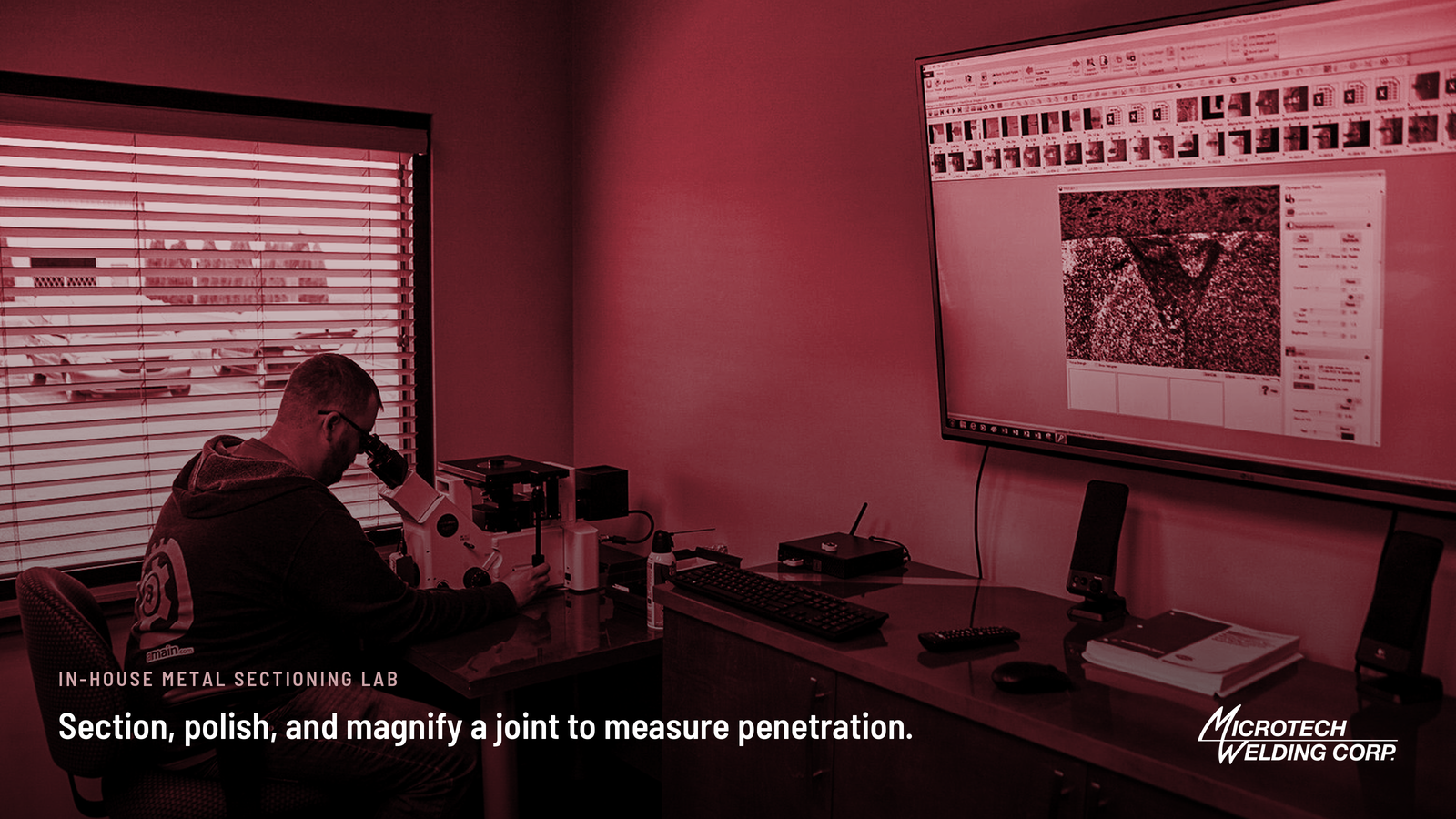
We use our in-house metal sectioning lab to section, polish, and magnify a joint so we can measure penetration and evaluate weld quality. On new development work, we weld samples, analyze them for anomalies, adjust settings, and repeat until the weld meets every acceptance criterion for the joint.
Send Us the Print and the Next Step
We’ve been doing precision welding since 1997. Every job runs through a quality management system certified to ISO 9001:2015 and, for our medical device work, ISO 13485:2016, with AWS D17.1 certified welders.
If your part is going to be machined, ground, polished, or textured after welding, let us know when you send the print. Knowing where the finished surfaces are and what the next operation needs helps us plan the weld. Contact our team to talk through your application.